

If you’re not spending much time outdoors, it’s a fair question: Do you really need to think about sunscreen? For many people, daily life looks more like time in the car, at a desk, or inside at home — not long hours in direct sun. It’s easy to assume that means your skin is protected. But sun exposure doesn’t only happen outside.
Can UV reach your skin through windows?
Short answer: yes — some of it can.
Not all ultraviolet (UV) radiation behaves the same way though. While glass blocks most UVB (the type responsible for sunburn), UVA can still pass through windows. UVA is the type of UV associated with ongoing, cumulative exposure. It doesn’t usually cause visible redness or discomfort, which is why it often goes unnoticed.
What actually gets through glass?
Rather than getting into technical detail, it helps to think about it simply:
- UVB: largely blocked by standard glass
- UVA: can pass through glass to some extent
This matters because UVA exposure doesn’t need to feel intense to have an effect. There’s no immediate feedback — no heat, no burn — just gradual exposure over time.
Where this exposure shows up in real life
This isn’t about extreme situations. It’s about everyday routines.
Common moments where UV exposure can still occur include:
- Driving or sitting in the car
- Working near a window
- Sitting in natural light at home
- Short walks between indoor spaces
Individually, these moments feel insignificant. But repeated daily exposure can add up over months and years.
A well-known example of window exposure
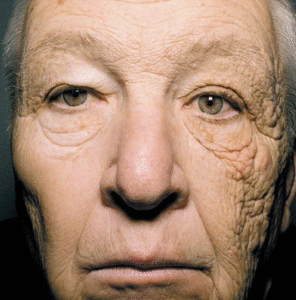
A commonly shared image of a long-haul truck driver shows more visible sun damage on the side of the face closest to the window. While it’s an extreme example, it helps illustrate how repeated, everyday exposure — even through glass — can accumulate over time. Most people aren’t spending hours driving each day. But shorter, consistent exposure — like commuting or sitting near windows — can follow a similar pattern on a smaller scale.
Why it doesn’t feel like it matters
One of the reasons this type of exposure is easy to overlook is that it doesn’t feel like sun exposure. There’s:
- No heat
- No redness
- No immediate change in the skin
We tend to associate sun damage with obvious signs, like sunburn. But much of the exposure that contributes to visible skin changes happens quietly, in the background of everyday life.
What this means for sun-damaged skin
Sun damage is rarely the result of a single day. It’s typically cumulative — built up over time through repeated exposure. Even lower levels of UV, experienced consistently, can contribute to changes in how skin looks and behaves, including:
- Uneven tone
- Dryness
- Loss of skin resilience
- Increased sensitivity
Supporting the skin barrier and maintaining overall skin integrity becomes especially important in these everyday conditions.
A simple way to approach daily exposure
Rather than thinking about sunscreen as something reserved for beach days or long time outdoors, it can be helpful to treat it as part of a consistent morning routine. A product like Defence SPF 50 is designed for this kind of everyday use. It combines broad spectrum SPF 50 with 5% Vitamin B3 (niacinamide), offering sun protection while also helping to support the appearance of sun-damaged skin.
Lightweight and non-greasy, it can replace multiple steps — making it easier to stay consistent, even when sun exposure doesn’t feel obvious. Vitamin B3 (niacinamide) is a well-researched ingredient known to support skin barrier function and help maintain healthy-looking skin.
Learn more about Defence here.